
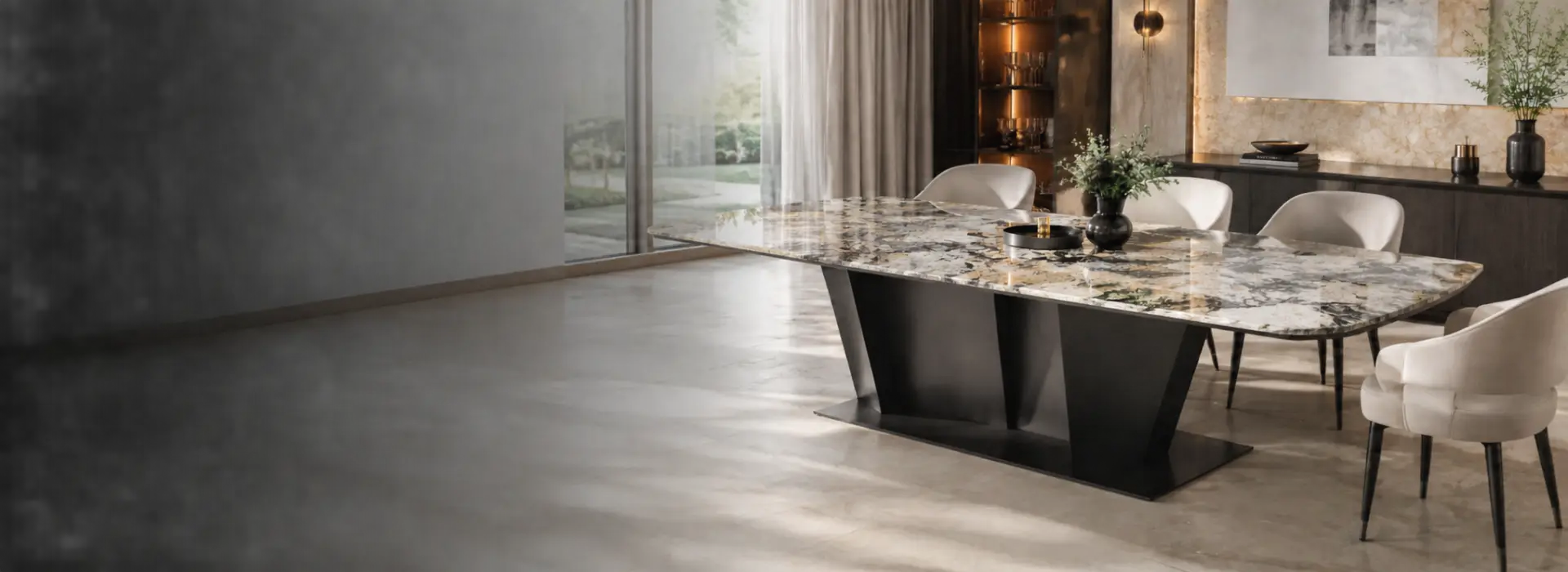
Custom Made Granite Dining Tables Manufacturing
GLM has more than 26 years of experience in natural stone production and has supplied stone products to customers in over 60 countries and regions. With in-house stone selection, machining, assembly and inspection, we can handle both standard furniture orders and custom project requirements.
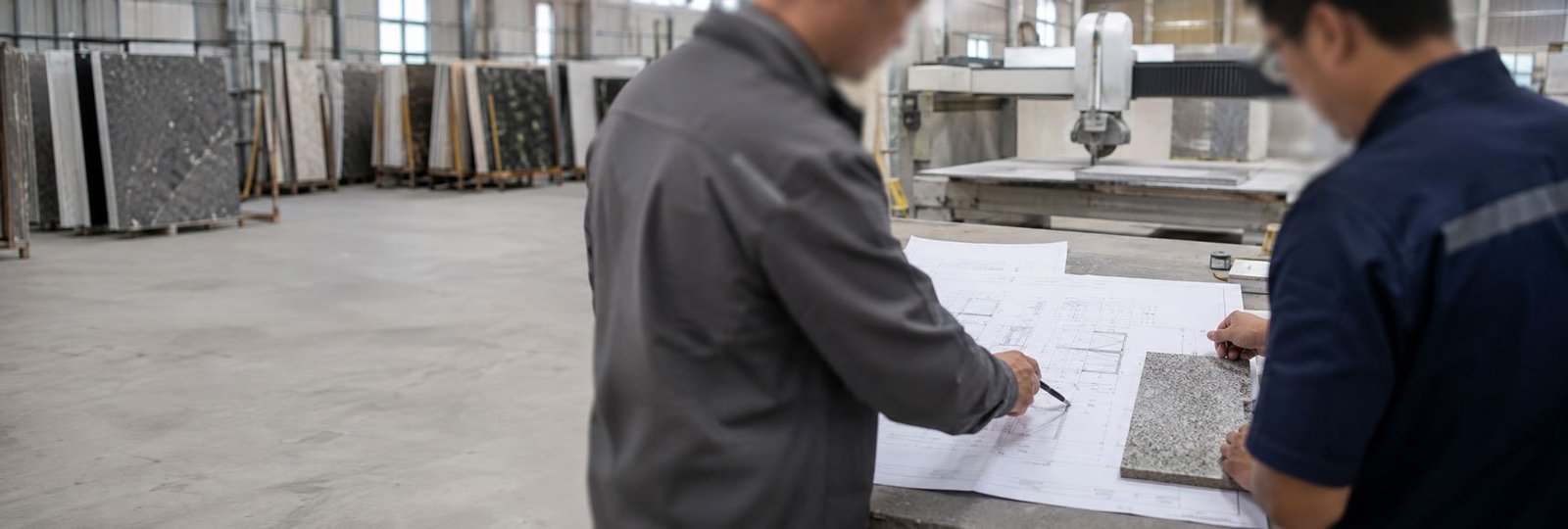
Granite dining tables can be produced with full stone bases or combined with metal and wood structures. Table size, stone color, edge profile, base proportion and surface finish can be adjusted from your drawing, reference image or project layout. For larger or heavier tops, the support position and base structure should also be checked before production.
If you already have a table design, required size, quantity or preferred granite, send the basic information.
Granite Dining Table Styles
Choose the table by granite color, tabletop shape, seating capacity and intended use. Sizes, edges and base structures can be adjusted according to the project drawing.
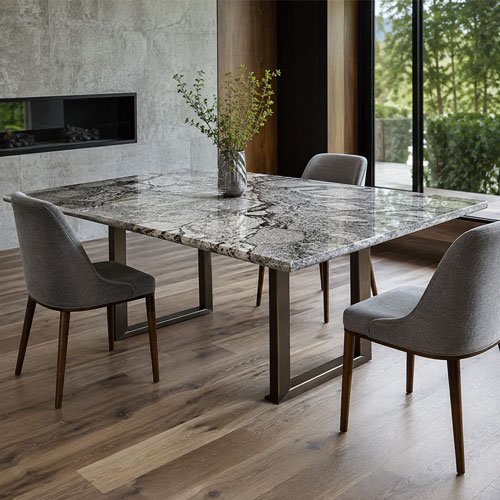
Natural granite tabletop combined with a stone, metal or wood base for residential and commercial dining spaces.
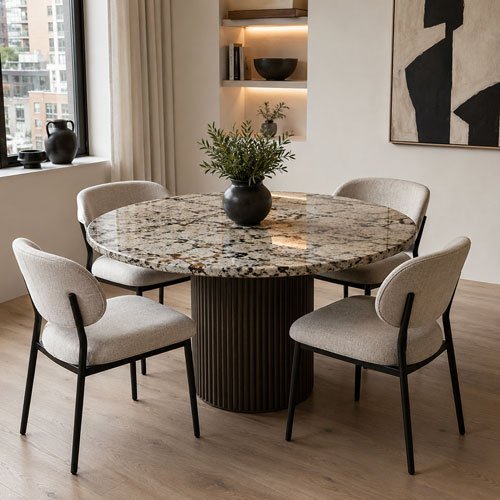
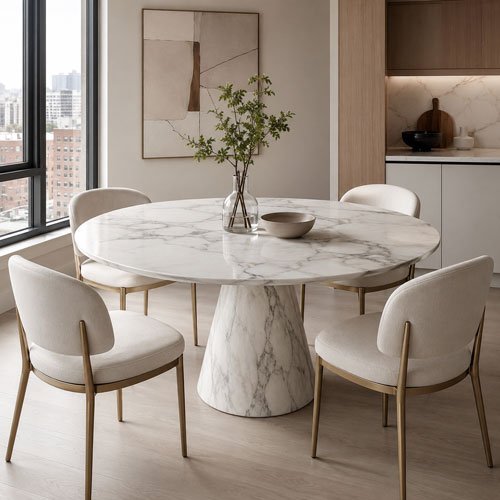
A round tabletop creates a balanced seating layout and works well in dining rooms with limited corner space.
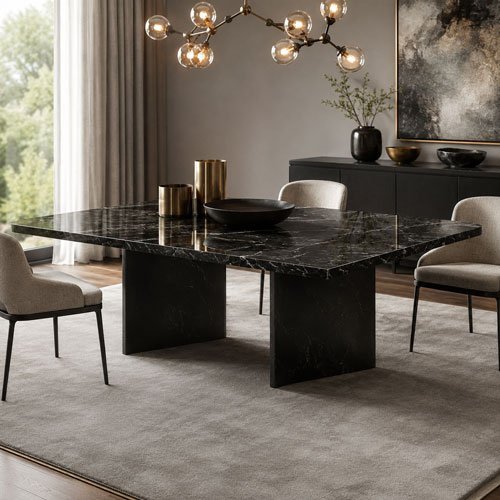
Dark granite gives the table a stronger visual weight and pairs well with metal, wood and neutral interiors.
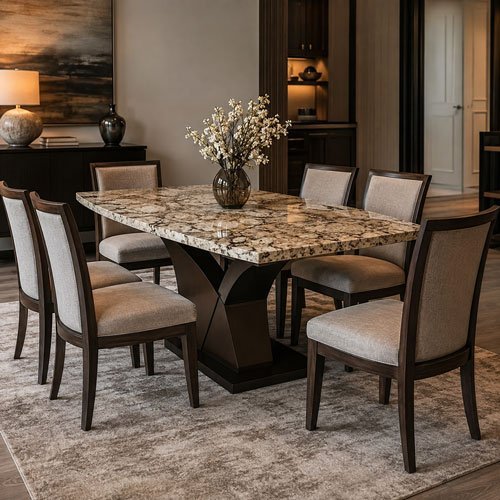
A coordinated dining table and chair set planned around the tabletop size, seating 4/ 6/8 numbers and project style.
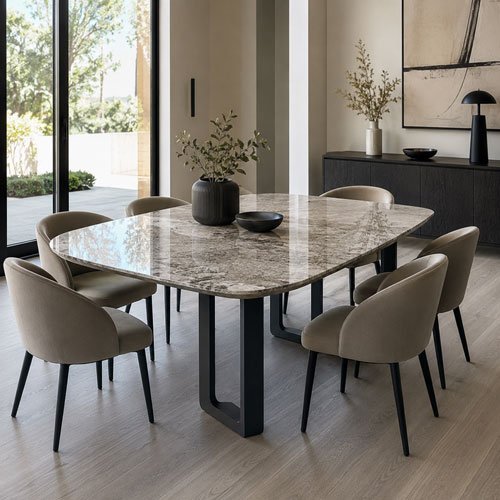
Clean lines, simple edges and a restrained base structure suit modern residential and hospitality interiors.
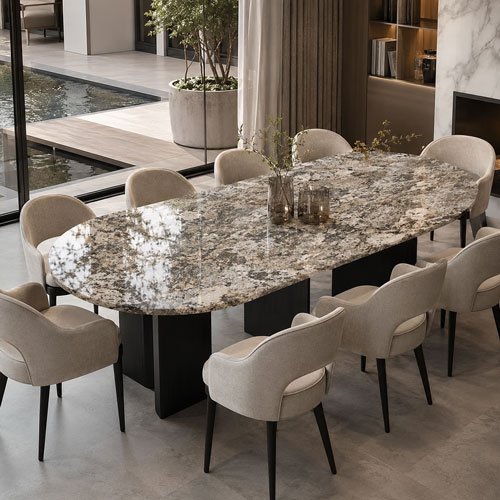
The oval shape provides a softer outline while offering more seating space than a small round table.
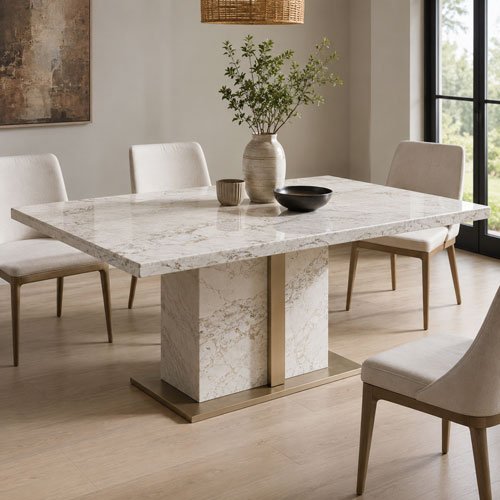
Light-colored granite creates a cleaner appearance while keeping the natural grain and durability of stone.
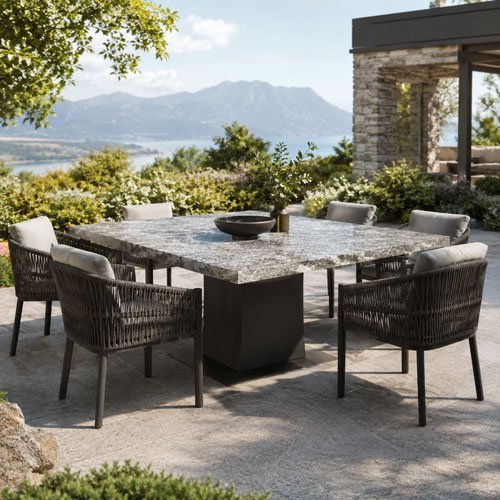
Granite dining table for patios, gardens and outdoor hospitality areas, with the finish and base selected for exterior use.
Key Features of Granite Dining Tables

Granite typically has a Mohs hardness of 6 to 7. It is not easily scratched by everyday utensils such as knives, forks, plates, or bowls, and is not easily damaged by knife impacts or heavy objects.

Granite with a high crystallization point allows hot pots and baking pans to be placed directly on the table without the need for an additional heat-resistant mat, and the table surface will not fade or turn white due to heat.

Rich in quartz and mica, with a mottled surface and feldspar crystals, each table has a unique pattern, making them natural works of art that exude quality and stability.

It is chemically stable, resistant to ultraviolet rays and freezing, and unaffected by acid rain or weather changes. Whether used indoors or outdoors in a patio, garden, or on a dining table, it will not fade over time.
Load-Bearing Design of Granite Dining Tables
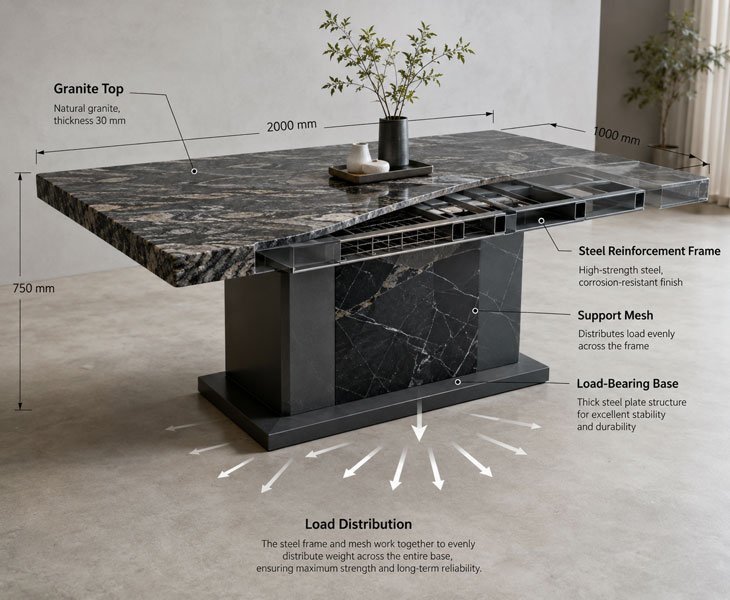
Granite dining tables are indeed beautiful, but considering their weight, how can we avoid potential wobbling and insufficient support? We use a load-bearing steel/stone base with a contact area 30% larger than the tabletop area. A steel frame support mesh is embedded within the base to distribute the weight of the stone and localized pressure, minimizing the risk of wobbling and breakage in the middle.
Ergonomically Designed Base
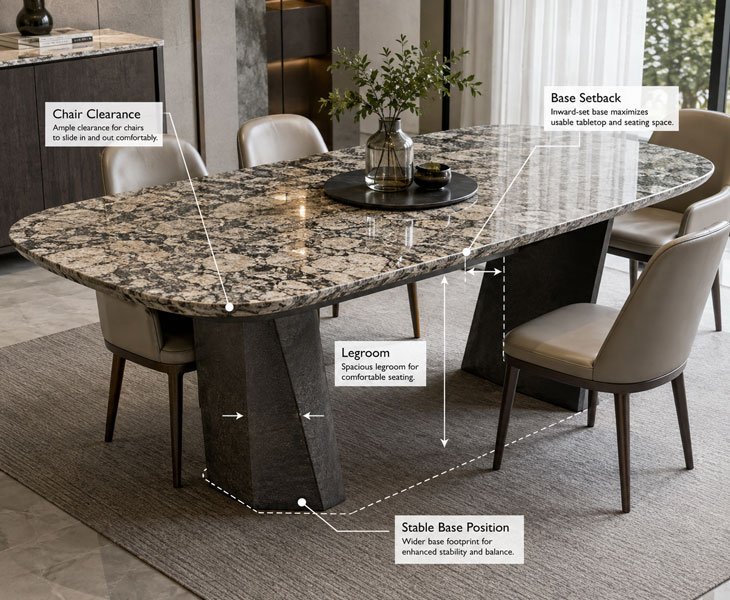
Using a sculpted base is problematic. A base that is too wide, positioned too far outwards, or with an unreasonable distance between the two pillars can affect chair placement and legroom, causing inconvenience in daily use. GLM designed the base with the edges tapered inwards by 25-30 centimeters to ensure legroom and allow the chair to be fully pushed in. This reduces the floor space while maintaining the stability of the stone tabletop.
Granite Dining Table Solutions by Project Type
The base is designed for stability on the tabletop, using custom-made foam padding and an A-frame fumigated wooden crate for secure mounting, reducing breakage. Standardized stone grading and layout are established to ensure consistency in bulk supply.

The tabletop is sealed with a penetrant for protection, making it resistant to alcohol, oil, and high-temperature stains. It has low daily maintenance costs. In commercial settings, the recessed base provides reinforcement and prevents the table from tipping over due to customers stepping on or bumping into it.
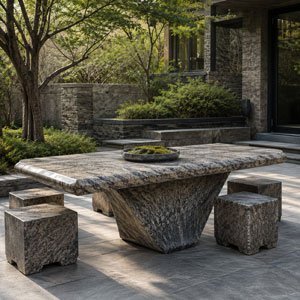
Supports five-axis CNC precision engraving and complex chamfering, maximizing the reproduction of sculptural bases and complex tabletop designs, minimizing discrepancies between the final product and the renderings, and supporting your customization needs.
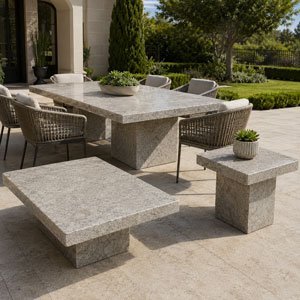
Made from carefully selected single-slab monograft granite, the modular packaging design solves the problems of elevators and narrow passageways. Ergonomically designed and space-optimized, it provides ample legroom for easy insertion of dining chairs.
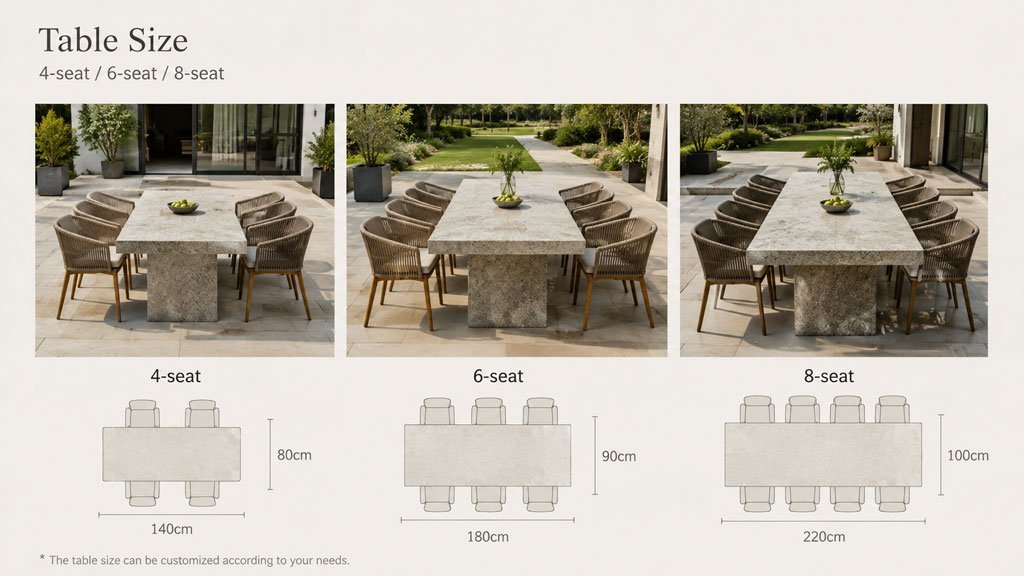
Granite Dining Table Specifications
- Table Size
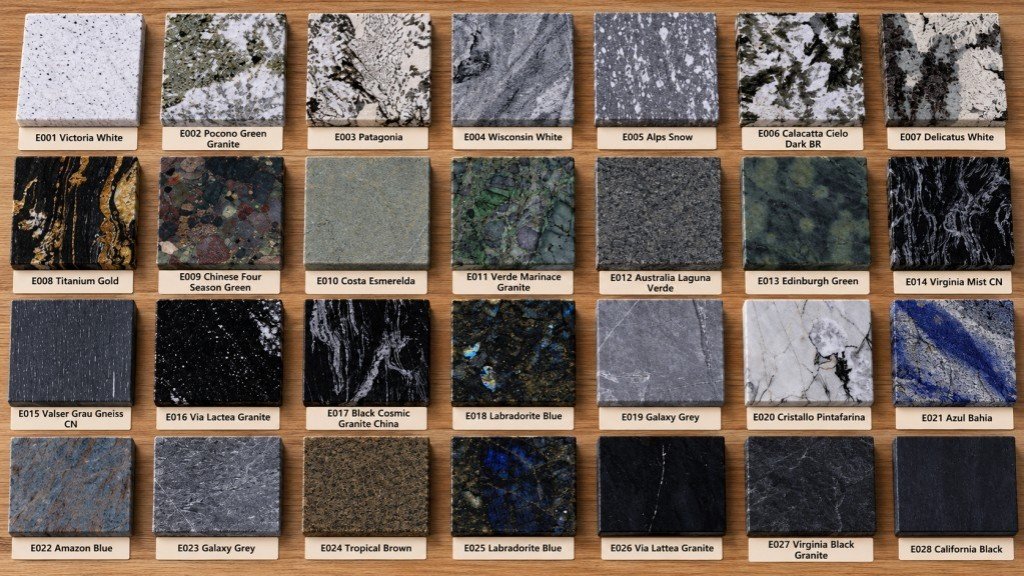
- Granite Material
- Surface Finish
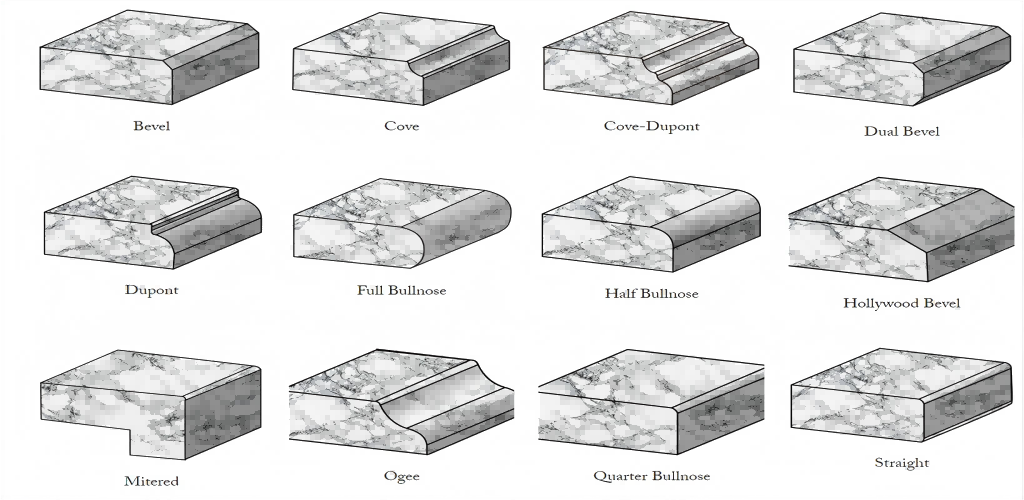
- Edge Profile

Yes, granite is heat-resistant and scratch-resistant. It is minimally affected by everyday tableware scratches and hot cookware, resists oil stains, and is durable, making it suitable for dining tables.
Yes, granite countertops have a natural texture and a solid feel. They are resistant to everyday scratches and can be cleaned and maintained with a damp cloth.
After selecting a different type of stone, design it according to the drawings, CNC cut the dimensions and edge shape, polish or matte the surface, composite or add a supporting steel frame to the bottom, seal the surface, and then complete the assembly and inspection.
A layer of wood or steel backing board is glued to the bottom of the stone, and then the base is fixed to the backing board with screws; the stone and the backing board are bonded together with high-strength structural adhesive or epoxy resin.
Yes, if they were manufactured in the same period, it is recommended to use slabs cut from the same batch of raw blocks. Otherwise, you can match them by comparing stones of the same name, or use designs with the same color scheme.
More Stone Tables for Dining and Project Spaces
-
-
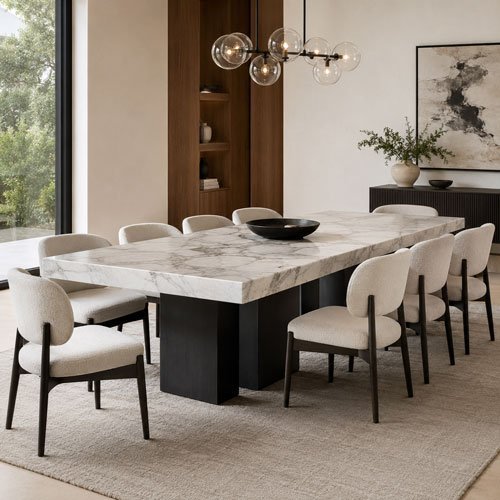 Rectangular Marble Dining Tables
Longer tabletop suits family, hospitality and project dining areas.
-
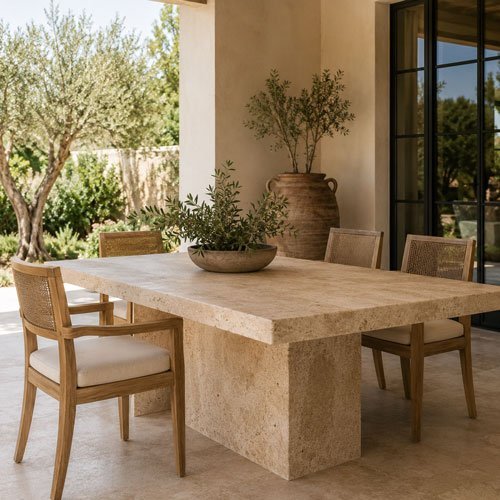
Warm natural texture suits patios and covered outdoor dining.
-
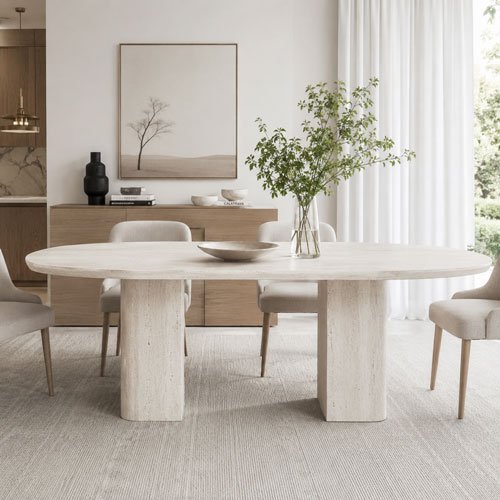 White Travertine Dining Table
Light cream tones create a calm, clean dining atmosphere.
-
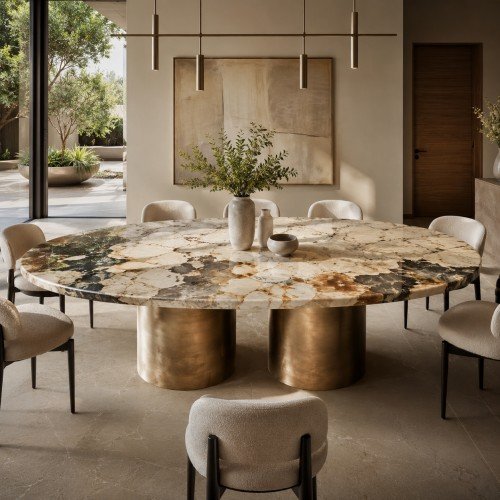
Bold crystal movement creates a strong luxury dining statement.
-
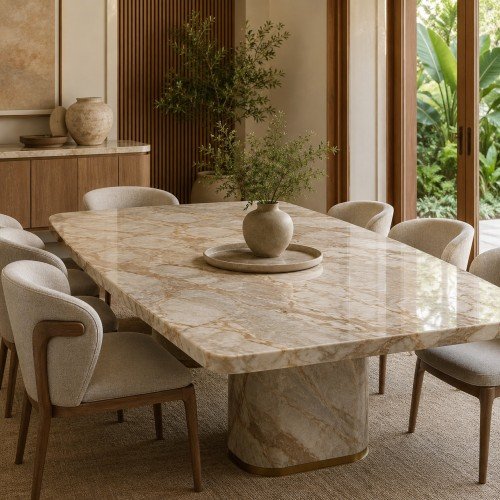 Taj Mahal Quartzite Dining Table
Warm neutral veining suits refined residential and hospitality interiors.
-
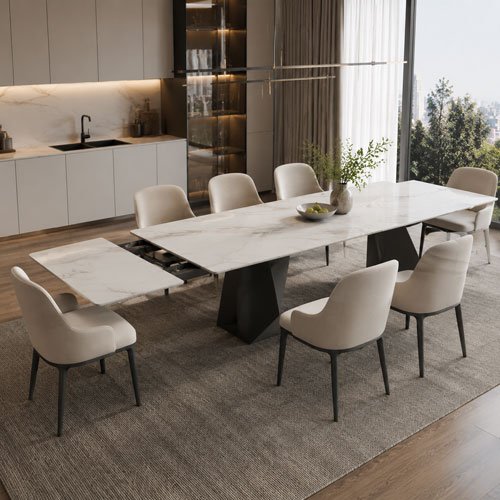
Flexible extension adds seating capacity for changing dining needs.
-
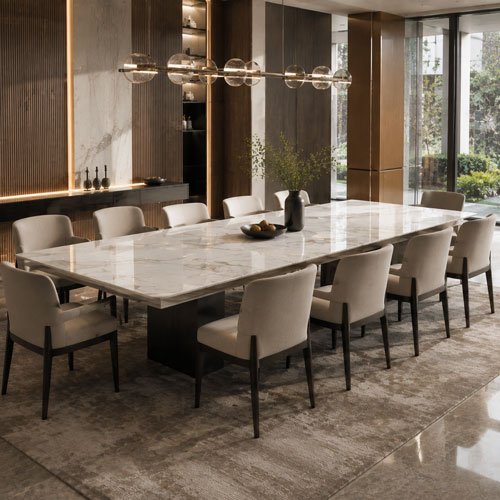 Sintered Stone Dining Table for 8
Large format supports spacious family and project dining layouts.
Custom Granite Dining Table Planning Guide
Granite dining tables typically have a hard surface that is resistant to scratches and oil stains. They’re also easier to maintain compared to lighter-colored marbles.
When customizing a dining table, factors such as color, size, chair placement, base support, table weight, surface finish, and shipping requirements need to be taken into consideration.
Chair size and leg space
Generally, leaving about 60 centimeters of space around the edge of the table is sufficient for one person to use it comfortably. If large dining chairs or armchairs are used, 70–75 centimeters of space would be more comfortable.
Some tables appear quite large in the drawings, but the chairs don’t fit completely under the tabletop. Users’ knees might also touch the base of the table legs.
When evaluating table sizes, we consider the clearance between the table legs, the overhang at the ends of the legs, and the distance from the lowest point under the tabletop.
Circular tables with a central base need to be checked again. The diameter of the base, the diameter of the tabletop, the weight of the stone material, and the way it’s fixed must all be consistent with each other.
For rectangular dining tables with double or T-shaped bases, the bases are typically moved inward to make space for the chairs at each end. The final position should be determined based on the actual width of the chairs.
Desktop weight
A solid granite countertop that’s 30 millimeters thick weighs approximately 75-80 kilograms per square meter, based on rough estimates.
For example, a desktop with dimensions of 2.4 meters by 1.1 meters could weigh nearly 200 kilograms. This doesn’t include the base, steel frame, or packaging materials.
For elevators of this size, it’s important to check their load-bearing capacity and fixing details as soon as possible. On-site personnel should also pay attention to the elevator’s load-bearing capacity and the routes along which it moves.
When the table size is large, the project owner or local engineers should confirm it.
Solid countertop or thick-edged appearance
For granite dining table tops, solid stone slabs 20 millimeters or 30 millimeters thick can be used. Another option is to join the edges at a 45-degree angle, creating a visual effect of 50 millimeters, 60 millimeters, or even thicker.
The thick-edge design eliminates the need for extremely thick sheets of material, but it also increases the workload required for handling joints. Processes like corner cutting, glue line treatment, polishing, and internal support become more important as a result.
It isn’t suitable for all design styles. Some simple tables look better with ordinary solid surfaces.
Steel frame and base support
There’s no fixed standard for the length of tables, and steel frames aren’t always necessary. It’s important to consider factors like the thickness of the stone, the width of the tabletop, the spacing between the legs, any overhanging parts at the edges, and the condition of the stone itself.
Tables with long spans or wide overhangs typically require additional support. Tables with detachable bases also need secure fixing points.
Polished, matte, or leather finishes
After polishing, the color of the granite and its mineral crystals become more clearly visible. The surface is smooth, making it easy to clean with regular wiping.
Darkly polished granite is more likely to show fingerprints, water marks, or dust. This should be taken into consideration in restaurants or areas with high foot traffic.
Matte and leather finishes reflect less light, so minor signs of wear may not be very noticeable. Deeper leather textures tend to retain oil stains or cleaning agents, so it’s best to check sample pieces before production.
Some granites have extremely low water absorption rates, so they may not require sealing treatments like stones with higher water absorption rates. If a sealant is used, its purpose is to reduce the absorption of stains, but it cannot completely prevent staining in granite.
For use indoors or outdoors
For indoor dining tables, the main things to consider are cooking oil, wine, coffee, and food stains.
Outdoor usage conditions vary. Local temperatures, freeze-thaw cycles, sunlight exposure, drainage conditions, and foundation corrosion all need to be taken into consideration.
For coastal or salt-fog environments, 316 stainless steel is a suitable choice. For general outdoor use, the type of metal and coating can be selected based on the specific conditions. A standard primer isn’t suitable for all applications.
Natural color variation
The background color, grain direction, or mineral patterns of granite slabs can vary. This is a normal phenomenon for natural materials and does not necessarily indicate any quality issues.
For bulk orders, we will try to use sheets from the same batch or with similar colors.
Even if the granite has the same name, the appearance of the stone in subsequent orders may vary. If color matching is critical, it’s advisable to keep some of the material from the first order as a backup.
Removable structure
Large granite dining tables typically feature a detachable tabletop and base, making them easier to package, transport, and handle on-site.
The desktop, base, and hardware components can be packaged separately. Each component should have a clear part number or installation markings.
Not all sculpture stone bases are suitable for a detachable design. Some shapes require a monolithic structure. The fixing method should be confirmed with the design drawings prior to production.
Export packaging
Solid wood packaging for export must comply with the requirements of the destination country and, where applicable, meet the provisions of International Standard for Phytosanitary Measures No. 15 (ISPM 15).
Before finalizing the dimensions of the large desktop, please check the width of doorways, elevator sizes, stair corners, and loading areas.
The direction of movement is also important. A long ladder might be wide enough to fit through the door, but it won’t be able to turn around in the hallway. Additionally, it’s necessary to consider the elevator’s load capacity and the number of workers involved.
Quotation Information
Length, width, and height of the dining table
Desktop thickness
Granite name, color, or reference photo
Polished, matte, or leather finishes
Straight edges, rounded edges, or 45-degree beveled edges
Basic drawings, reference diagrams, or 3D files
Order Quantity
For use indoors or outdoors
Is it necessary for the table to be detachable?
Destination port or delivery address
Some details may not be clear at first. We can determine the general direction for now. Once this information is clarified, the quote will be more accurate.